
Summary
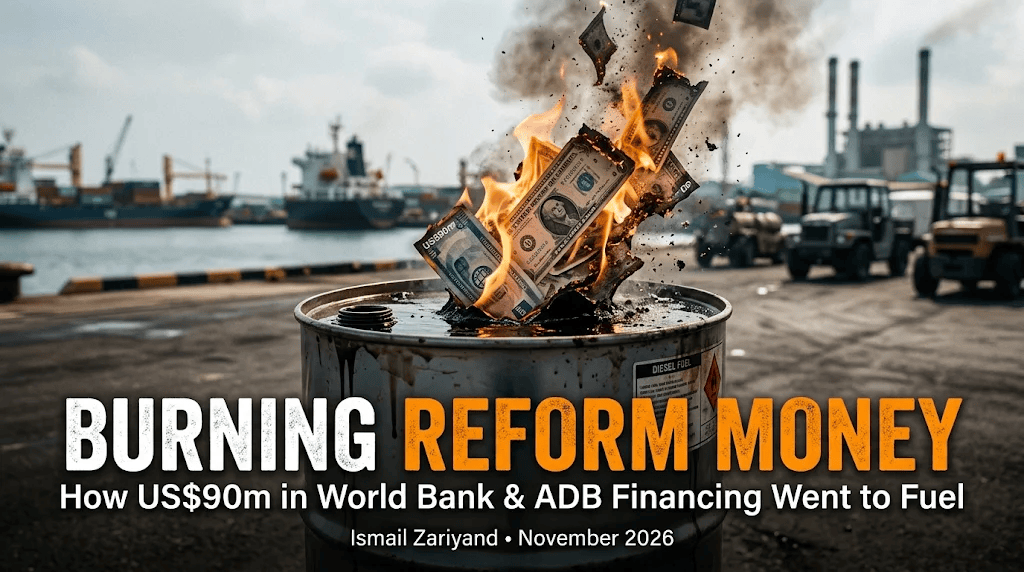
In 2026, the Maldives raised US$90 million to pay for fuel imports. US$40 million came from the World Bank, approved on 4 May, and US$50 million from the Asian Development Bank (ADB), approved in August. The World Bank money was taken from development projects already under way. The ADB money is new borrowing.
The conflict in the Middle East pushed global oil prices up more than 38% after 28 February 2026. The government’s difficulty in managing public finances, and its reluctance to take the corrective measures advised by international institutions, had already widened the foreign currency gap between imports and exports and pushed exchange rates up. Usable foreign exchange reserves fell below one month of import cover. About 186 island powerhouses depend almost entirely on imported diesel (World Bank, 2026a), as do resorts and industrial islands. Fuel imports averaged US$63.7 million a month in 2024–25, about 10% of GDP a year (World Bank, 2026a). By May 2026 they had reached US$116 million a month, up from about US$50 million before the conflict (Atoll Times, 2026). Buying the fuel was unavoidable.
The World Bank Contribution to the Fuel Emergency Support
The Maldives Emergency Support for Critical Services Project (P516182), also called M-FUEL, was approved on 4 May 2026 for US$40 million (World Bank, n.d.). Its Project Information Document describes the money as “restructuring and recommitment of unwithdrawn balances” from three IDA projects. It lists them as SAILS (US$20.70m), the Competitiveness and Growth Project (US$13.20m) and the Urban Development and Resilience Project (US$1.76m), for a subtotal of US$35.66m (World Bank, 2026a). The IPF Policy allows this. Paragraph 12 allows the Bank to use condensed procedures in urgent cases, and the funds can come from restructuring existing projects (World Bank, 2021).
The World Bank documents do not account for the full US$40 million. The PID labels US$40m as “IDA recommitted” but names sources for only US$35.66m (World Bank, 2026a). The SAILS restructuring paper records a US$21.0m cancellation, US$0.30m more than the PID lists, and names no other contributing project (World Bank, 2026b). As the published record stands, US$4.34 million of the US$40 million remains unexplained. Project P516182 is an IDA credit, so all this money is a loan, not a grant.
The three projects that were cut
| Project | Original (US$m) | Moved to fuel (US$m) | Progress and audit record |
| Sustainable and Integrated Labor Services, SAILS (P177240) | 24.00 | 20.70 | Rated Moderately Unsatisfactory in October 2025. The unemployment insurance scheme has been removed, and the upskilling target cut from 1,000 people to 300 (World Bank, 2025, 2026b). |
| Maldives Competitiveness and Growth Project, MCGP (P179286) | 15.00 | 13.20 | Approved in May 2023 and still active. About 88% of its funding has been withdrawn. No recent public rating or audit found (World Bank, 2023). |
| Maldives Urban Development and Resilience Project, MUDRP (P163957) | 16.50 | 1.76 | The Auditor General found that US$9.85m (60%) had already been cancelled because of policy changes and poor coordination between agencies (Atoll Times, 2025). |
SAILS was meant to build the Maldives’ first contributory unemployment insurance scheme and integrated employment services. After the cut, about US$3m of the project remains (World Bank, 2026b). Unemployment insurance is the safety net that would have protected tourism workers in this very crisis. Removing it saves money now, but it leaves every future shock to fall on household savings and the state budget.
MCGP aims to bring private participation into SOEs and make SMEs more competitive (World Bank, 2023). STO, the company buying this fuel, is itself an SOE. Reforming SOE governance would reduce the losses, guarantees and bailouts that drain the budget year after year. Cutting it trades a permanent fiscal saving for one month’s fuel.
MUDRP had already lost drainage, sewage treatment, firefighting capacity and a new NDMA building to earlier cancellations (Atoll Times, 2025). The latest cut takes more from what was left for urban planning and emergency preparedness. For low-lying islands, that preparedness is cheap insurance against flood and disaster losses that would cost far more later.
The ADB loan and ADB’s ongoing portfolio
The ADB approved US$50 million (MVR 772.5 million) under the Energy Security Emergency Assistance Project (60245-001), and the government has signed the agreements (Atoll Times, 2026; Ministry of Finance, 2026). Unlike the World Bank package, it does not appear to divert money from existing ADB projects. ADB’s project data sheet names its source as concessional ordinary capital resources lending (ADB, 2026a). The ADB’s emergency assistance loan rules, widened in July 2026 to cover energy supply and food price shocks, allow this use (ADB, 2026b).
The ADB’s existing portfolio here is struggling. At the end of 2025 it held 8 loans and 17 Asian Development Fund (ADF) grants worth US$277.3m net. The disbursement ratio was only 11.9%, with delays due to late government counterpart funding, procurement problems, and limited capacity (ADB, 2026c). The main ongoing operations are the Greater Malé Waste-to-Energy Project (US$171.6m in total, US$73.9m from ADB), the Greater Malé Environmental Improvement and Waste Management Project, and Preparing Outer Islands for Sustainable Energy Development (POISED) (ADB, 2021, 2026c). If implemented faster, these projects would cut diesel dependence, the real cause of this crisis.
Loan or grant? Both packages are loans: the World Bank money is an IDA credit and the ADB money is a concessional loan, so both must be repaid. The Maldives qualifies for ADF grants because it is at high risk of debt distress (ADB, 2026c), yet it took this emergency money as debt.
Conclusion
The US$90 million buys less than one month of fuel. All of it is debt. To raise it, the country gave up a labour safety net, SOE reform and disaster preparedness, the very reforms that reduce the need for emergency borrowing. A self-reliant Maldives cannot be built by borrowing for consumption and cancelling its own reforms to do it.
References
Asian Development Bank. (2021). Tackling the solid waste management challenge in Maldives [Partnership report]. https://www.adb.org/multimedia/partnership-report2021/stories/tackling-the-solid-waste-management-challenge-in-maldives/
Asian Development Bank. (2026a). Maldives: Energy Security Emergency Assistance Project (60245-001): Project data sheet. https://ewsdata.rightsindevelopment.org/files/documents/01/ADB-60245-001.pdf
Asian Development Bank. (2026b). Enhancing ADB’s crisis response modalities to address energy supply and food price shocks: Policy paper. https://www.adb.org/documents/enhancing-adb-crisis-response-modalities-address-energy-supply-and-food-price-shocks-policy-paper
Asian Development Bank. (2026c). Country partnership strategy: Maldives, 2027–2031. https://www.adb.org/sites/default/files/institutional-document/1183366/cps-mld-2027-2031.pdf
Atoll Times. (2025, July 3). Audit reveals cancellation of 60% of disaster management funding. https://atolltimes.mv/post/news/12789
Atoll Times. (2026, August 12). ADB approves $50 million emergency loan for Maldives fuel imports. https://atolltimes.mv/post/business/16799
Ministry of Finance and Public Enterprises. (2026). Loan signing for “Energy Security Emergency Assistance Project” between the Government of Maldives and Asian Development Bank. https://mfr.mv/15/loan-signing-for-energy-security-emergency-assistance-project-between-the-government-of-maldives-and-asian-development-bank
World Bank. (n.d.). Finances One: Maldives. Retrieved November 23, 2026, from https://financesone.worldbank.org/countries/Maldives
World Bank. (2021). Bank policy: Investment project financing (OPS5.03-POL.110). https://thedocs.worldbank.org/en/doc/6da2e812c0b8e84a1a614bb3c0507e5a-0290012023/original/Bank-Policy-Investment-project-financing.pdf
World Bank. (2023). Project information document: Maldives Competitiveness and Growth Project (P179286). https://ewsdata.rightsindevelopment.org/files/documents/86/WB-P179286_6SHjjtF.pdf
World Bank. (2025). Implementation status and results report: Sustainable and Integrated Labor Services (SAILS) (P177240), sequence no. 6. https://documents1.worldbank.org/curated/en/099030525022038949/text/P177240-5c27436b-b696-4461-8e0c-ed28105f67d7.txt
World Bank. (2026a). Project information document: Maldives Fuel for Utilities and Essential Logistics Emergency Project (P516182). https://documents1.worldbank.org/curated/en/099031426062016416/pdf/P516182-6ab7ec6c-e439-4dcc-a7d8-a76cc28fe530.pdf
World Bank. (2026b). Restructuring paper on Sustainable and Integrated Labor Services (SAILS) (P177240) (Report No. RES01968). https://documents1.worldbank.org/curated/en/099082426062038179/pdf/P177240-a643dcc9-4906-40bd-951d-73e006cba9be.pdf


Leave a Reply