
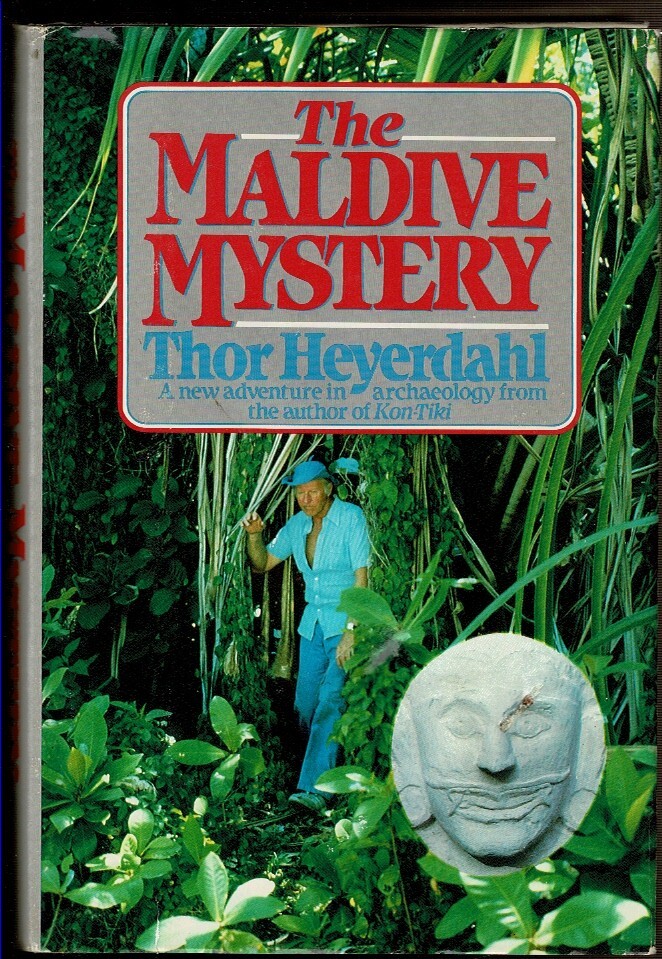
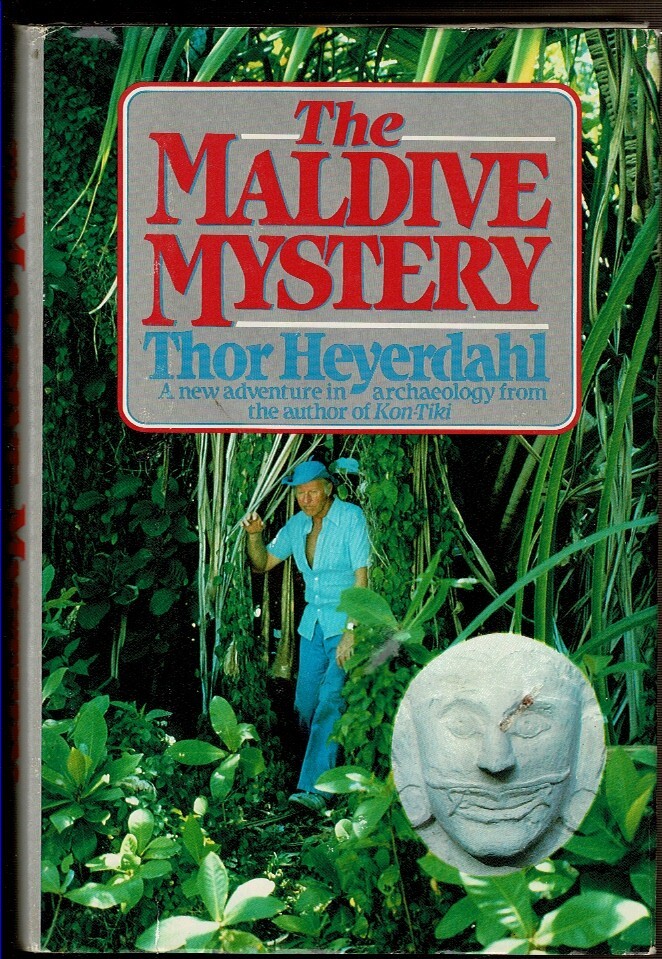
Most of us were taught that Maldivian history begins in 1153, with the conversion to Islam. Everything before that is treated as a blank page, or as a time of ignorance best left alone. I recently reread Thor Heyerdahl’s The Maldive Mystery (1986), and it reminded me how much that blank page actually holds. It also made me think about the questions: debt, dependency and who really controls our economy.
Heyerdahl, the Norwegian explorer famous for the Kon-Tiki raft, came to the Maldives in 1982 at the invitation of President Maumoon Abdul Gayoom. With Maldivian scholars such as Hassan Maniku and Mohamed Loutfi, along with a team of Norwegian archaeologists, he excavated at Fuvahmulah, Gaafu Gan, and Nilandhoo. His conclusion was simple and striking. Long before 1153, these islands were home to an organised, literate and wealthy kingdom that traded with the whole known world.
This is not a review of an old book. It argues that our own past has something to teach us about the present.
Who came first? The early migrations
Heyerdahl’s team concluded that the Maldives were not discovered by fishermen drifting off course. They were settled by people who were already skilled seafarers, builders and traders, and they came in several waves from several directions (pp. 301–302).
Islanders from Fuvahmulah to the northern atolls told him about the Redin, a people said to have come before the Maldivians, who spoke another language and built the great stone mounds we call hawitta. Whether the Redin were a real, distinct people is impossible to prove. But the memory of them appears at both ends of the archipelago, and H.C.P. Bell recorded the same name decades earlier at Miladhoo (pp. 55–58).
Our own chronicles also admit we were not the first. The legendary first king, Koimala, could settle in Malé only with the permission of an older community on Giraavaru island, who believed they descended from Tamil Buddhists (pp. 277–280). Sri Lanka’s ancient chronicles describe Prince Vijaya’s “Lion people” sailing from Bharuch in Gujarat around 500 BC, with one of their ships reaching an island of women (p. 281). Carvings, beads and religious objects found here point both to Sri Lanka and to the old ports of north-west India (pp. 300–303).
Heyerdahl’s summary is that Buddhists from Sri Lanka and Hindus from north-west India arrived in roughly the same century, about 2,500 years ago, and absorbed whoever was here before them (p. 312). We are, from the very beginning, a nation built by seafarers.
How old is Maldivian Civilisation?
The firmest date in the book is AD 550. Carbon tests on shells and charcoal from the temple complex at Nilandhoo in Faafu atoll all date to the same centuries. That is six hundred years before our official history begins (p. 302). Even then, the builders reused finely cut stones from an older structure, so something stood there earlier still.
Other evidence pushes the story further back:
- A Roman silver coin, minted in 90 BC, was found inside the stupa at Thoddoo in 1958 (p. 308).
- The Roman historian Ammianus Marcellinus records envoys from the Divi, the Maldives, bringing gifts to Emperor Julian around AD 362 (p. 309).
- Maldivian money cowries were found at Lothal, a port of the Indus Valley civilisation that declined around 1900 BC. This shows our shells were already being traded abroad, even if it does not prove people lived here (p. 300).
- Pottery from the Vaadhoo lagoon near Malé was identified informally as neolithic, older than 2000 BC. This is the weakest claim in the book and needs proper scientific testing (p. 307).
You do not need to accept every theory to accept the main point. Maldivian history did not begin in 1153. It was rewritten in 1153.
The mint of the Indian Ocean
For me, this is the most remarkable part of the book. For roughly a thousand years, the Maldives supplied the money of the Indian Ocean world.
The money cowrie, Cypraea moneta, was harvested and processed here and exported by the shipload. It was used as currency in Bengal, Thailand, East Africa and as far as Mali in West Africa. Heyerdahl calls the archipelago “a sort of bank or mint” for the surrounding continents (p. 156). Through Arab traders and the Volga trade routes, Maldivian cowries even ended up in graves in Finland, Sweden and northern Norway (pp. 304–305).
The foreign record is consistent across six centuries:
- Sulaiman the Merchant (AD 850–900) wrote that the wealth of the islanders was cowries, and that their queen kept large stores of them in royal depots. He added that there were no people more industrious (p. 156).
- Al-Biruni (around 1030) called the Maldives the “Cowrie Islands” and described the shells as a Maldivian monopoly (pp. 157, 305).
- Ibn Battuta (1343–44) recorded the exchange rate: 400,000 cowries to one gold dinar, and sometimes three times as many (p. 157).
- Ma Huan, with Admiral Zheng He’s fleet in 1433, saw cowries shipped in heaps to Bengal and Thailand (p. 157).
Cowries were not our only product. Ibn Battuta lists exports of dried fish, coconuts, coir rope sold as far as China and Yemen, cotton cloth, turbans and copper vessels (p. 211). The Portuguese chronicler Correa describes something even more impressive: Maldivians bought raw silk, gold thread and cotton yarn from passing ships, wove them into fine fabrics, and sold the finished cloth back to those same ships. That is value-added manufacturing and re-export, five hundred years ago (p. 214).
We were also carriers, not just hosts. Maldivian ships sailed to Calicut, Cambay, Hormuz, Bengal and Yemen. A Persian envoy in 1442 listed Maldivian merchants at Hormuz alongside traders from Egypt, China and Java. As the historian A. Gray put it, in that era “free trade prevailed” and no single nation dominated the carrying trade (pp. 212–213).
That world ended when Portugal arrived in 1498 and replaced open trade with blockades and monopoly. In 1503 a Portuguese commander seized four Maldivian ships off Calicut. In 1519 they built a fort in Malé and forced our people to sell their produce at whatever price the commander chose (pp. 214–215).
Statecraft and governance before 1153
The kingdom that converted in 1153 was not a collection of scattered fishing villages. It was already a single state ruled from Malé, with vassal rulers in the atolls (p. 207).
It was a literate state. Our ancestors wrote royal records on copper plates in their own script, Eveyla Akuru. One such copper book, the Lōmāfānu, lists kings of the Lunar Dynasty from 1105. It was written by a professional scribe and signed by twelve ministers, including the Commander-in-Chief and the Treasurer. In other words, we had a cabinet and a treasury before we had a sultan (pp. 205, 208).
Arab visitors noticed other features. In the tenth century, they recorded that the islands were ruled by a queen, by long custom (p. 208). Ibn Battuta himself served as chief judge under a sultana. The state kept a standing army of about a thousand men, many of them foreign-born, paid in imported rice (p. 209). Ibn Battuta describes clean, tree-shaded streets, well-built homes and a population so averse to violence that people fainted when a thief was punished (pp. 209–210).
The conversion itself was an act of statecraft. No Arab army ever invaded. A single scholar, Abu al-Barakat Yusuf al-Tabrizi from Tabriz in Persia, arrived and persuaded the king (pp. 198–201). The historian Hassan Maniku gave Heyerdahl a blunt explanation for why the king agreed: it was “pure politics”. Sri Lanka was a powerful Buddhist neighbour, close enough to threaten us. The Arab world was far enough away not to interfere in our affairs, yet strong enough to deter anyone who tried (p. 207). The faith changed, but the nation stayed the same.
The queens of the south, and a theory that crosses oceans
The southern atolls kept memories of their queens long after Malé tried to erase them. On Hithadhoo in Addu, a guide showed Heyerdahl a small pool still known as “the Queen’s bath”, its walls robbed for house-building stones (p. 34). In the thicket beside Fuvahmulah’s great mound, his team found another ceremonial bath “possibly of the type that the queen had used on Hitadu” (p. 48). Fuvahmulah also holds a precisely built square bath, aligned exactly to the compass points (p. 62), and a round one locals call Vasha veo (p. 75).
The queen with a name is Khanzi of Gaafu Gan. Two elders on Gaddhoo, said to be over 100, told Heyerdahl that her people lived on Gan after the Redin and before the Sinhalese “cat people” drove them out (pp. 86–87). Heyerdahl links her to the Arab record of AD 916 that the islands had always been ruled by a queen, and to the sultana Ibn Battuta served (pp. 181, 208). Women ruling here before Islam is documented, not just legend.
Heyerdahl went further, and this is where readers should take care. He saw striking parallels between Maldivian finds and ancient America:
- Stone heads with stretched “long ears”, like the Easter Island statues and Inca nobles; he traced the custom to the Indus Valley port of Lothal (pp. 14–16, 73).
- Demon faces from Malé that looked more like Mayan carved stones than anything else in the Indian Ocean (p. 25).
- A twelve-cornered block in an old mosque on Kuda Huvadhoo, which he compared to the famous Inca wall in Cusco (p. 141).
- Fuvahmulah’s baths, which reminded him of the pre-Inca bath at Chan Chan in Peru (p. 71).
- Maldivian log rafts built like the earliest drawn balsa rafts of Peru (p. 154).
He even proposed a route: on the north-east monsoon to the Cape of Good Hope, then on Atlantic currents to the Gulf of Mexico (pp. 71–73). But he admitted himself that the links might be coincidence: “Perhaps yes. Perhaps no” (p. 16). Most scholars see these as similar customs that developed separately. What is proven is enough: the Maldives sat on the ancient sea highways linking India, Sri Lanka, Arabia, Persia, Rome and China.
Lessons on sovereignty, self-sufficiency and debt
History does not hand us policy. But it does give us a mirror, and the reflection is uncomfortable.
We once issued money. Today we borrow it. For a thousand years, other nations held Maldivian cowries as their currency. Today it is the reverse: we hold other nations’ debt, borrowed in their currencies, on their terms. The difference between a nation that issues value and a nation that borrows it is the difference between sovereignty and dependency.
We once added value. Today we mostly export raw fish. Our ancestors imported raw silk and gold thread and exported finished cloth. Five centuries later, we still ship most of our fish unprocessed and import almost everything else, including the food on our tables. That is not a geographic destiny. It is a policy choice.
Our location is an asset, but only if we trade as equals. The Maldives prospered when the sea lanes were open, and many nations competed for our goods and services. We suffered when one power tried to monopolise those lanes. The lesson is clear: diversify our partners and never allow a single creditor or a single patron to control our economic routes.
Our ancestors balanced powers; they did not surrender to one. If Maniku is right, the kings of 1153 chose a distant ally precisely so that no nearby power could dictate to them (p. 207). Real sovereignty means keeping every great power at arm’s length. Swapping one dependency for another is not a foreign policy.
Our darkest hour came from inside. We were truly conquered only from 1558 to 1573, when a sultan abandoned his people for the Portuguese, and the occupiers ruled through a local collaborator. Freedom was won back by islanders from Utheemu, not by foreign friends (pp. 215–216). Sovereignty is rarely lost to an enemy at the gate. It is usually traded away by leaders chasing personal power.
Food dependency is an old weakness. Even the medieval royal army was paid in rice imported from Bengal (p. 209). A nation that cannot feed itself cannot fully govern itself. Food security is not an agricultural issue; it is a sovereignty issue.
Our heritage is an economic asset we are wasting. The great mound at Fuvahmulah was plundered (p. 46). The contents of the Thoddoo stupa, including that Roman coin, disappeared after 1958 (p. 308). A temple site in Malé lies under a service centre (p. 27). Protected sites, proper museums and heritage tourism could add a cultural product to an economy that relies too heavily on resorts and borrowing.
A nation that once stood on its own
The Maldivians described in this book were literate, organised, industrious and outward-looking. They ran a state, kept accounts, manufactured goods, sailed their own ships and supplied the currency of half the known world. They dealt with every power in the Indian Ocean and were owned by none of them.
We do not need to return to cowrie shells. But we do need to recover that confidence: the belief that a small island nation can be a producer rather than a borrower, a partner rather than a client. Our ancestors managed it with wooden ships and palm-leaf sails. We have far fewer excuses.
A note on sources: this article is based on Thor Heyerdahl, The Maldives Mystery (London: Unwin, 1986; page numbers in brackets refer to this edition), which draws on H.C.P. Bell’s surveys, the Maldivian copper-plate chronicles and the accounts of Ibn Battuta and other travellers. Some of Heyerdahl’s theories, particularly about the earliest settlers and sun worship, are speculative and debated by scholars. The dates and trade records quoted here come from documented sources cited in the book. Archaeological work since 1986 may have refined some of these findings.


Leave a Reply