
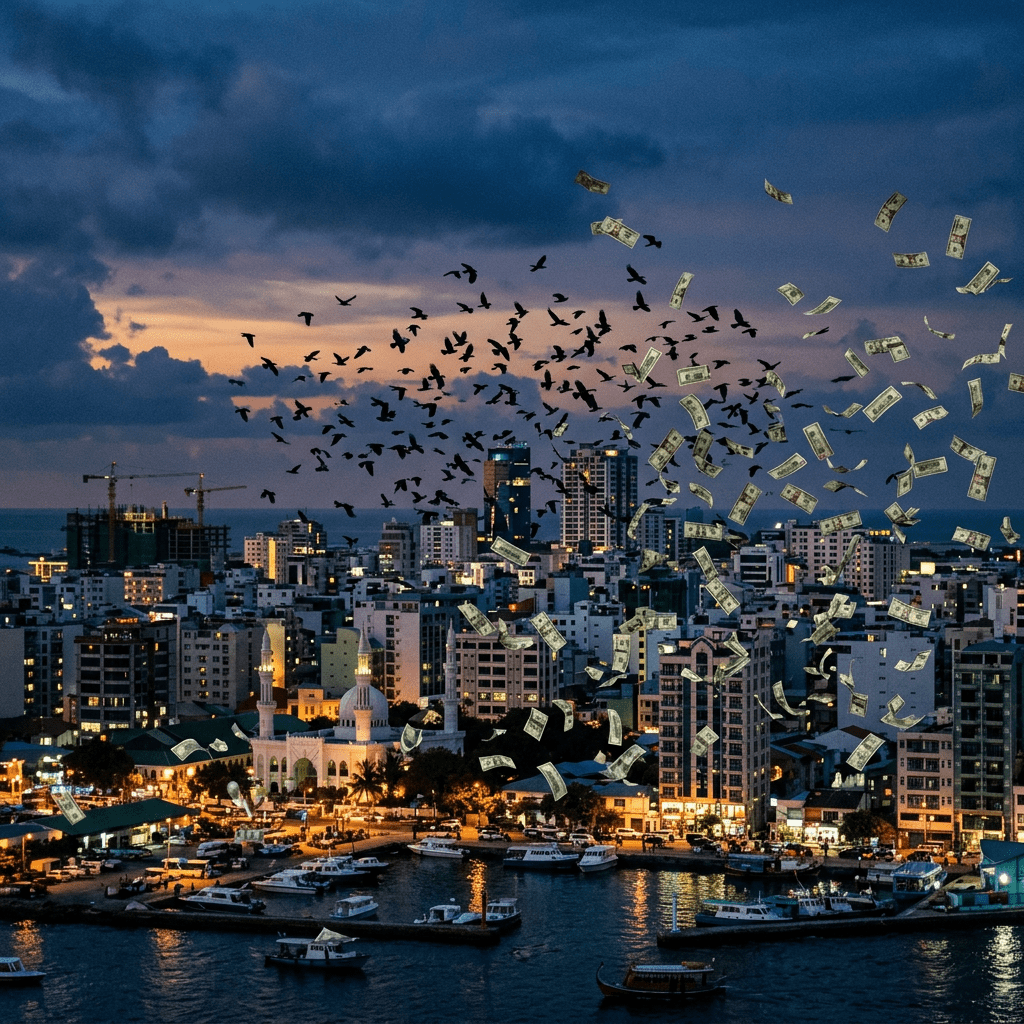
BML rationed the public’s dollars in May and asked for them back in June. Its own audited accounts explain why: nearly half the bank now stands lent to the state.
Within the space of a single year, the Bank of Maldives (BML) has told its customers three different stories. In July 2025, it began charging fees of up to 30% on Rufiyaa debit card transactions at certain online shopping platforms. On 2 May 2026, it tightened the screws: daily limits on foreign currency spending at major e-commerce sites, a cap of thirty online transactions per customer per month, and new measures on how cards could be used and telegraphic transfers (TT) sent. Payments began failing even on sites the bank had previously not named. Importers I have spoken to describe TT payments for goods purchased abroad taking between six and fourteen days to reach their suppliers’ accounts delays that would once have been unthinkable for routine trade. Then, on 30 June 2026, the very same bank unveiled a “US Dollar Investment,” inviting customers to deposit their foreign currency with BML in exchange for returns of up to 25%.
A bank that rations your dollars in May and comes asking for your dollars in June is not announcing a new product. It is confessing a problem. And the question that confession raises is a large one: why does the Maldives’ largest bank need to raise dollars from the public in this manner?
What the silence conceals: debt that never appears as debt
BML is a majority state-owned institution: the government holds 66.27%, directly and through state-owned enterprises (SOEs). The legal responsibility for regulating banks, maintaining financial stability, and managing the exchange rate rests with the Maldives Monetary Authority (MMA). No banking activity of this kind could be introduced without the central bank’s knowledge, and yet neither BML nor the MMA published any regulatory framework or explanation of how such a product affects the country’s foreign currency position before launch. That silence is itself telling.
When regulatory disclosure is absent, the audited record must speak instead. By reading BML’s published financial statements alongside the audited reports on state-owned enterprises (SOEs), an evidence-based picture of the state’s finances can be assembled. What it shows is a government borrowing heavily through the banking sector, with BML as the state’s largest domestic lender and, beyond that, SOEs borrowing from banks and foreign lenders in their own names and passing the same money to the Treasury as T-bills and bonds. The practical result of borrowing this way is that these obligations never appear as direct government debt. This is precisely the “sovereign-bank nexus”, the perilous entanglement of state debt and the banking system that the IMF and the World Bank have warned about repeatedly since their assessment of the Maldivian financial sector in 2023.
Dollars owed, dollars lent: a balance sheet tilted toward the state
BML’s 2025 annual report shows that the bank’s holdings of government securities rose by roughly 46% in a single year, from about MVR 13.3 billion to approximately MVR 19.4 billion. About 35% of the bank’s balance sheet now consists of government paper.
The dollar dimension is the most striking. The US dollar-denominated government securities on BML’s books nearly quadrupled in one year, from MVR 913.96 million to MVR 3,660.78 million. In 2024, dollar government paper accounted for about 6% of BML’s total USD assets; by 2025, it was 20.5%. One in every five dollars the bank holds against its customers’ dollar deposits has been lent to the government in dollar-denominated instruments. The bank’s overall dollar position is negative: USD assets of MVR 17,862.7 million against USD liabilities of MVR 18,150.9 million. The bank owes more dollars, mostly to its own depositors, than it holds. While customers queued under card limits, the bank’s US-dollar lending to the sovereign quadrupled, and its US-dollar Liquidity Coverage Ratio fell from 160% to 131%.
Total exposure to the government and its related entities stood at MVR 25,090 million, 44.9% of the balance sheet, including the statutory deposit at the MMA. Even after removing that regulatory deposit, discretionary exposure is MVR 21.76 billion, or 39% of total assets. Nearly two in every five rufiyaa on the bank’s books is, in substance, a loan to its own controlling shareholder. The strain shows that cash and cash equivalents fell by 63% despite record profits. And the headline Capital Adequacy Ratio of 48.1% looks reassuring only until one recalls that Maldivian regulation permits a zero risk-weight on government securities, including foreign-currency ones, so the bank holds no capital at all against its sovereign portfolio.
The State’s Debt, in the Companies’ Names
BML’s direct exposure is only the visible half. The audited statements of the few SOEs whose accounts have been completed reveal an indirect channel running through their balance sheets.
State Trading Organisation (STO)’s 2025 audited financial statements show BML’s exposure to the company rising roughly fifteen-fold in a single year, from MVR 70.5 million to MVR 1.08 billion. The largest new facility, MVR 800 million at 6%, maturing in 2028, is secured by a lien over government Treasury Bills. Of the total exposure, MVR 846.8 million is T-bill-collateralised, while MVR 478.2 million in financial investments is pledged to BML. The mechanics are straightforward: STO holds the sovereign’s paper, pledges it to the sovereign’s bank, and receives cash in return. Although recorded as corporate lending, the credit risk never leaves the government’s perimeter; it is simply relabeled.
Surprisingly, in 2025, STO borrowed MVR 771 million, equivalent to USD 50 million at the pegged rate, from CFSIT Inc, an affiliate of the Cargill group’s trade-finance arm, at SOFR + 7%, with a 2027 maturity, under a sovereign guarantee. In the same year, STO invested the same amount in Government Treasury Bills at the same return and similar maturity. On the face of the audited accounts, STO appears to have functioned as an intra-public-sector financing intermediary for the Government.
Maldives Airports Company Limited (MACL) shows the pattern from another angle. MACL’s 2024 audited statements show the balance of six BML demand loans standing at MVR 1.9 billion at the end of 2023, all secured by mortgage over the Hulhulé leasehold rights to the nation’s airport at 150 to 200% of the exposure. On 26 December 2023, MACL drew a USD 50 million loan from BML; the same statements show MVR 771 million, equal to USD 50 million at the pegged rate, invested in Government Treasury Bonds that same year. In June 2024, MACL drew a further USD 30 million from BML; and “additional USD 30 million was invested in Treasury Bond from Government of Maldives” during that same year. Twice over: the amount borrowed and the amount placed with the government match within the same period. The loans cost 8–8.5%; the bond pays 8%. The airport company borrows against the nation’s airport and passes the money to its owner at a loss on the spread.
Nor do the channels end there. The audited reports completed so far for the SOEs show the same banking system supporting the state’s companies on both sides of the balance sheet. MTCC’s 2024 accounts disclose MVR 463 million in borrowings from banks and financial institutions, secured against more than MVR 1.4 billion in mortgaged infrastructure, the dredger Mahaa Jarrafu among the pledged assets. MIFCO, whose accumulated losses reached MVR 1.04 billion by end-2024, with the Auditor General flagging material uncertainty over its survival, runs on bank overdrafts of MVR 618.5 million, every facility propped up by a government guarantee. Across the audited record, profitability makes no difference to the SOEs’ access to borrowing; the state guarantees, and the banks hold the paper.
The IMF Saw It Coming
None of this should surprise anyone who reads the international assessments. The IMF World Bank Financial Sector Assessment Program report of March 2024 found that commercial banks’ claims on the central government had reached 30.4% of banking assets by 2023, with banks holding roughly half of total domestic debt. It identified the enabling mechanism, the zero risk-weight, and its stress test found that, in a severe scenario, system-wide capital adequacy could fall by 14.8 percentage points, leaving banks undercapitalised. It noted the cost to everyone else: private-sector credit in the Maldives stands at roughly 31% of GDP, far below upper-middle-income norms, because banks prefer “riskless” sovereign paper to lending to businesses. The accompanying Financial System Stability Assessment was explicit: systemic risk in the Maldives flows principally from the sovereign-bank nexus, high dollarisation, and foreign currency shortage.
BML’s accounts confirm that the condition the IMF described has not been treated; it has deepened. Government paper alone is now 35% of the largest bank’s balance sheet, and total exposure to the state 44.9%. When the IMF’s Article IV mission visited Malé in June 2026, it credited the authorities with meeting debt obligations on time and warned, in the same statement, that the risk of debt distress remains high, with downside risks prevailing.
April explains May and June
The foreign currency obstacles the public has faced, and the TT delays businesspeople describe, have precise coordinates in the official data. On 2 April 2026, the government paid and discharged the USD 524.68 million sovereign Sukuk. The banking system’s total foreign currency assets, MVR 22.13 billion at the end of March, fell to MVR 12.90 billion by the end of April, a drop of roughly MVR 9.22 billion in a single month. Foreign currency balances held by the government and public institutions collapsed by roughly 90%, from MVR 5.79 billion to MVR 576.6 million. The MMA’s own Reserve Data Template shows official reserve assets falling 46% in April alone, from USD 1.33 billion to about USD 718 million.
The sequence tells the story by itself. The state’s debt was paid in April. The public’s card limits were cut in May. The public was asked for its dollars in June. The hardship experienced by thousands of businesses and customers was not a natural disaster. It was the burden of servicing the state’s debt, passed down the line until it reached the pockets of the ordinary public standing at the back of the queue and a balance sheet with a negative net dollar position and a fifth of its dollar assets locked in government paper will manage that shortage the only way it can: by controlling the timing of every outflow. The six-day TT is that balance sheet, experienced one payment at a time.
Where the complaint belongs
Given how deeply BML is entangled with the state’s debt, the principal complaint about the measures now squeezing its customers should not be addressed to the bank. This is the condition of a state that has managed its debt by borrowing and remitting the foreign currency that exists within the country, rather than earning it by raising the country’s productivity. It will be remedied only to the extent that the government’s leaders and the state’s financial professionals make prudent decisions, disclose the true financial position to the people, and choose to escape this situation with the public’s participation rather than at the public’s expense. The Auditor General has published the evidence. Ernst & Young and Deloitte have signed the accounts. The IMF has issued the warnings. Financially heavy days lie ahead, and safety from the storm before us will depend on how well we prepare. Forewarned is forearmed.
(This blog post was initially published in the opinion column: BML ge massalaeh heyyeve? Nuvatha dhaulatuge massalaeh heyyeve? | އަދަދު by the writer)
Note by the Author: The USD 50 million equivalences of STO’s and MACL’s MVR 771 million subscriptions are the author’s computations at the pegged rate of 15.42; the audited notes print these amounts in Rufiyaa. The identification of CFSIT Inc as a Cargill-affiliated lender is based on corporate and litigation records, not the audit report. All other dollar figures are printed in the cited notes. TT delay durations are drawn from the author’s interviews with importers.
Sources
Bank of Maldives PLC, Audited Financial Statements FY2025 (Ernst & Young, 24 February 2026): Notes 19, 37.6.3, 42.5; cash flow statement. BML press release MKT/PR/2026/26, 30 June 2026. State Trading Organization PLC, Audited Financial Statements FY2025 (Deloitte): Notes 27.3, 27.11, 31.4. Maldives Airports Company Limited, FY2024 Audited Financial Statements, Auditor General’s Office Report FIN-2025-43(E), 27 May 2025: Notes 19.1, 19.2, 24.1.12, 24.1.15, 29(v). MTCC Annual Report 2024, Note 15. Maldives Industrial Fisheries Company Limited, FY2024 Audited Financial Statements, AGO Report FIN-2025-90(E), 31 July 2025: going-concern paragraph and Notes 19, 19.1–19.3. IMF/World Bank, Maldives Financial Sector Assessment Program, March 2024, and Financial System Stability Assessment. IMF, Staff Concluding Statement, 2026 Article IV Mission, June 2026. MMA, Reserve Data Template and Monetary Statistics, April 2026.


Leave a Reply