
What the IMF, World Bank, and Rating Agencies Are Really Saying About the Maldives
We live in a time when information and media are used to distort the truth for political purposes, turning facts into whatever shape is most convenient. This is particularly acute when it comes to reports and assessments published by international institutions on the Maldives’ financial position. At a moment when the government is selectively presenting these reports to the public in the way it prefers, when legally mandated financial disclosures are being delayed, and when annual audits are taking longer than they should, a vast gap has opened between the picture of success the government wants you to see and the lived financial reality of ordinary Maldivians. Never in the fiscal history of this country has the gap between international warnings, the real numbers of the state’s finances, and the government’s ‘bright outlook’ rhetoric been this wide.
This article examines the opinions published by the rating agencies and the reports released by the World Bank, the Asian Development Bank, and the IMF over the past six months. The IMF’s full Article IV report for both 2025 and 2026 has not been published with the government’s consent. We therefore rely on the end-of-mission press statements. Reading all of these reports together, the aim is to present an honest financial picture of where this country stood at the midpoint of 2026 in the eyes of the international community.
I. HOW RATING AGENCIES AND MULTILATERAL INSTITUTIONS SPEAK DIFFERENTLY
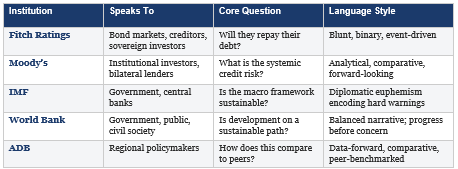
When international financial institutions publish their reports on the Maldives’ economic and fiscal position, they do not all speak to the same audience. The government tends to flatten all of these into a single narrative. But the language, structure, and core purpose of each institution’s reporting are shaped by who it is actually speaking to and understanding this is the first step to understanding what is actually being said.
Rating agencies such as Fitch and Moody’s publish their assessments for one audience: international investors, bondholders, lenders, and fund managers. Their reports are not written for Maldivian citizens. Every finding is structured around a single question: ‘Will we get our money back?’ Their language is blunt and binary because a single notch on their scale can move billions of dollars in capital.
Multilateral institutions the IMF, World Bank, and ADB speak to a fundamentally different audience: policymakers, finance ministers, and central banks. Their language is diplomatic, calibrated to maintain the government relationships they need to deliver development programmes and maintain annual access. They use what appears to be careful, measured language, but that language encodes hard warnings that must be decoded rather than taken at face value.
II. FITCH AND MOODY’S: WHAT THE RATING AGENCIES ARE SAYING
On 3 June 2026, Fitch Ratings upgraded the Maldives’ rating from CC to CCC, a one-notch improvement. However, this must be understood in its full context: in 2024 alone, the Maldives was downgraded twice from B− to CCC+ in June, and to CC in August. The June 2026 upgrade recovers only one of those two notches. CCC− means default remains a realistic possibility. Investment grade begins at BBB, eight notches above where we currently stand.
The Fitch upgrade was narrowly triggered by the April 2026 Sukuk repayment and final coupon totalling USD 524.68 million, paid from the Sovereign Development Fund (USD 350 million) and usable reserves (USD 175 million). The upgrade reflects the removal of the most immediate cliff edge, not an improvement in structural fiscal health. Fitch’s forward projections tell the real story: the 2026 fiscal deficit is projected at 14.6% of GDP more than double the government’s own 7.1% target. Gross reserves cover less than one month of external payments, against a peer median of 3.9 months.
On Moody’s: Moody’s current rating is Caa2. In November 2025, Moody’s upgraded its outlook from negative to stable, citing the growth of the Sovereign Development Fund (SDF) to USD 126 million as a key indicator of improving reserve adequacy. The problem is that the SDF, which Moody’s credited as evidence of strengthening liquidity, now holds approximately USD 21 million after the Sukuk payment. The very foundation of the stable outlook has been removed. A formal Moody’s post-Sukuk rating action has not yet been published at the time of writing, but whether the stable outlook survives the post-April data is a question the government has not answered publicly.
Both Fitch’s CCC and Moody’s Caa2 sit at the deepest level of the speculative-grade scale, signalling that default remains a realistic possibility. The government has presented the Fitch upgrade as a vindication of its economic management. The honest reading is different: we went from ‘highly likely to default’ to ‘default is still realistically possible.’ These are not the same as financial strength.
III. THE IMF ARTICLE IV MISSION: READING PAST THE DIPLOMACY
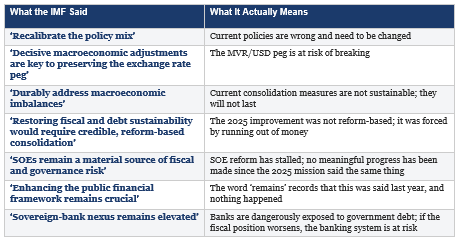
The IMF’s full Article IV staff reports for both 2025 and 2026 have not been published. In both years, the authorities stated they needed more time to consider the release of the full report. When governments withhold consecutive Article IV reports, it is typically because the findings are materially more critical than what appears in the diplomatic public statement. The press statement is the floor of the IMF’s concern, not the ceiling.
The IMF’s June 2026 end-of-mission statement is written in the language of multilateral diplomacy. Its words must be decoded:
The IMF projects real GDP growth of just 1% in 2026, down from 5.4% in 2025. In a country where almost all government revenue is tourism-dependent, 1% growth means fiscal targets will be missed as a mathematical certainty. The current account deficit the gap between what the country earns and what it spends in foreign currency is projected to widen further as import bills rise and tourism revenue softens.
IV. THE WORLD BANK: WHAT THE BALANCED LANGUAGE CONCEALS
The World Bank’s June 2026 Maldives Development Update is the most balanced in tone of all five publications because the World Bank has an active project portfolio in the Maldives and needs government cooperation to deliver it. Reading it accurately means looking past the balance to find the load-bearing sentences.
GDP growth is projected to collapse to 0.7% in 2026, down from 6.3% in 2025, a downward revision of 3.2 percentage points from the Bank’s own October 2025 estimate. Official reserves fell from USD 1.3 billion in March 2026 to USD 717.9 million by May, following the Sukuk repayment in April. Usable reserves the funds actually available for imports and exchange rate defence remain below one month of imports. The SDF, estimated at USD 80 million as recently as July 2025, is effectively depleted after the April payment.
The fiscal deficit is projected to widen back to 13% of GDP in 2026–27, as no meaningful expenditure reforms are expected and infrastructure spending is likely to increase. Public debt is heading toward 135% of GDP over the medium term and above 140% over the longer term. The Fiscal Responsibility Act 2013 mandates a deficit ceiling of 3.5% of GDP and a debt ceiling of 60% of GDP. Both have been violated every year since 2019 by every administration.
The World Bank’s most important sentence is buried mid-report: the 2025 fiscal improvement was ‘temporarily contained by liquidity constraints, ’ meaning the deficit narrowed because there was no money to spend, not because the government chose to reform. Capital expenditure cuts were not accompanied by reductions in commitments, resulting in unpaid bills accumulating. The Bank explicitly notes ‘reported financial difficulties in many sectors and state-owned enterprises.’
V. THE ADB: THE NUMBER THE GOVERNMENT WILL NOT CITE
The ADB’s Asian Development Outlook April 2026 projects growth at 1.0% in 2026, down from 5.4% in 2025. The slowdown is attributed to the unwinding of last year’s fishing surge, the dampening effect of the Middle East conflict on tourism revenue, rising energy costs, and, critically, the exhaustion of fiscal and external buffers that would normally allow a government to cushion the impact of an external shock. When tourism slows, most governments can increase public spending to offset the impact. The Maldives cannot. The buffers are gone.
The most important number in the entire ADB report is one the government has not cited: per capita GDP growth of negative 0.6% in 2026. Every other institution discusses aggregate GDP. The ADB reminds us that when population growth is factored in, the average Maldivian is getting poorer in real terms this year. With inflation projected at 5%, households face a double squeeze: incomes are declining while prices rise. The aggregate economy grows 1%. The average citizen gets poorer. That gap is the most honest single measure of where this country stands.
The ADB also uniquely highlights Aasandha as a structural fiscal fault line: the Maldives spends 9.2% of GDP on healthcare, comparable to advanced economies such as Australia and Japan, but lacks the fiscal capacity to match it. Aasandha expenditures have exceeded their approved budget every year since 2020, running at approximately 2% of GDP annually, with drug prices far above international benchmarks due to fragmented procurement and weak price controls.
VI. THE INDIA SWAP: DEBT PILED ON DEBT
The repayment of the USD 500 million Sukuk in April 2026 was presented by the government as a historic achievement. What was not prominently disclosed is the financial architecture that made it possible. On 23 April 2026, the very day the Maldives settled a USD 400 million RBI currency swap that had been drawn in October 2024, India approved a new INR 30 billion facility (approximately USD 357 million) under the SAARC Currency Swap Framework 2024–2027. The Maldives Foreign Ministry confirmed both events in the same press release.
The RBI’s own official framework document, published on 27 June 2024, describes this facility in terms the government has never quoted publicly: it is a ‘backstop line of funding for short-term foreign exchange liquidity requirements or balance of payment crises’ available ‘till longer-term arrangements are made.’ That is the RBI’s own language: temporary, short-term, and explicitly conditional on the absence of structural solutions.
The INR 30 billion is received in rupees, not dollars. It cannot be used directly to pay USD-denominated debt service or todefend the MVR/USD peg. Under the original SAARC framework terms, individual drawdowns carried a maximum maturity of three months with up to two rollovers a maximum effective tenure of nine months. The 2024–27 framework allows extended bilateral tenors, but the specific maturity of the current drawdown is contained in an unpublished bilateral agreement. What is known is that it must mature before the framework expires in 2027. The RBI has now extended cumulative swap support of approximately USD 1.1 billion to the Maldives since 2012. Each drawdown buys time. None resolves the underlying imbalance. This is not financial independence. It is managed by bilateral dependency.
VII. CONCLUSION: WHAT MUST BE DONE
The international community’s assessment of the Maldives’ fiscal position in the first half of 2026 is consistent across five separate institutions. Growth has collapsed to between 0.7% and 1%. Per capita income is declining. The fiscal deficit will widen back to 13-14% of GDP. Public debt is heading toward 135-140% of GDP. Usable reserves cover less than one month of payments. The SDF is effectively empty. Subsidy reform has not happened. SOE restructuring has not happened. The public financial management framework remains too weak to be trusted. And two consecutive IMF full reports have been withheld from the Maldivian public.
The Sukuk is paid. That is acknowledged. But it was paid by depleting three years of SDF accumulation in a single month, and by rolling one Indian bilateral facility into another on the same day. That is not financial strength. That is a one-time settlement of a long-deferred obligation using saved resources followed immediately by a new liability to the same bilateral partner.
If the government truly has the well-being of the Maldives and its people at heart, it must urgently review the fiscal framework, reduce wasteful expenditure, strategically diversify the economy’s foreign-currency earning capacity, and disclose accurate information to the public. Five of the world’s most authoritative financial institutions have now said so, in formally published assessments, within the space of three weeks. The question is not whether the diagnosis is clear. The question is whether those in authority have the will to act on it.
Note by the publisher: This article is a translation and expansion of an original Dhivehi opinion piece on Dhauru new (https://dhauru.com/post/opinion/44464). One factual correction has been applied: the original text incorrectly described the Fitch rating action as a downgrade from CCC to CC. The correct fact, confirmed by Fitch’s 3 June 2026 press release, is an upgrade from CC to CCC−. All other facts and figures in the original have been verified against primary sources: Fitch Ratings (June 2026), Moody’s Ratings (November 2025), IMF Article IV End-of-Mission Statements (February 2025 and June 2026), World Bank Maldives Development Update (June 2026), ADB Asian Development Outlook (April 2026), RBI SAARC Framework Press Release (June 2024), MMA Quarterly Statistics, MoF Quarterly Debt Bulletin Q4-2025, and AGO Report FIN-2026-58(E).


Leave a Reply