
An Opinion Piece Based on Economic and Public Finance Principles
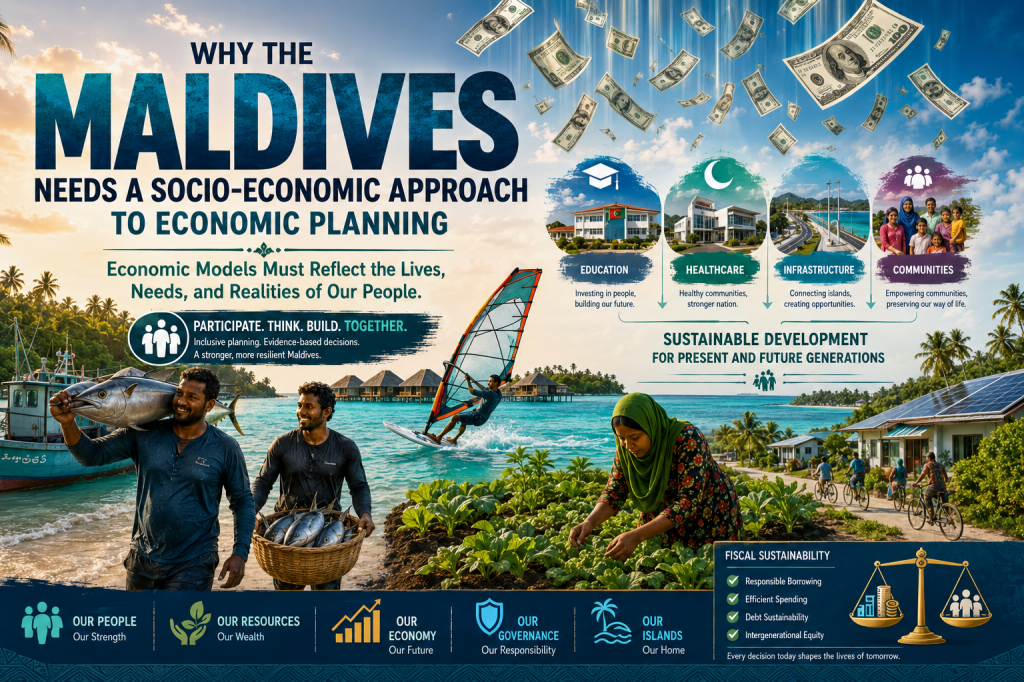
For many years, economic success in the Maldives has been measured through indicators such as GDP growth, tourism arrivals, government revenue, and infrastructure development. These indicators are important, but they do not tell the whole story. The Maldives’ experience during and after the COVID-19 pandemic demonstrates why economic policy cannot be evaluated solely by growth statistics. A country may experience economic recovery while simultaneously facing rising debt obligations, foreign-exchange pressures, inflation, and long-term fiscal risks.
This is why socio-economic analysis is so important. Socioeconomics examines not only economic growth but also how policies affect people, communities, institutions, public finances, and future generations. For a small island nation such as the Maldives, socio-economic analysis should be the foundation of national planning, budgeting, and development policy.
Most major economic theories were developed in large, industrialised countries. Classical economics emerged during the Industrial Revolution. Keynesian economics was developed in response to the Great Depression in the United Kingdom and the United States. Later theories, such as monetarism and supply-side economics, were also designed within the context of large, diversified economies.
These theories provide valuable insights, but they were not developed with countries like the Maldives in mind. The Maldives has a small population, a narrow economic base, heavy dependence on imports, limited domestic production, high transport costs, and significant exposure to external shocks. Tourism contributes a substantial share of government revenue, employment, foreign exchange earnings, and economic activity. As a result, economic disruptions affecting global travel can rapidly affect every aspect of national life.
The COVID-19 pandemic provided a clear example. When international tourism collapsed, government revenues fell sharply and private sector activity slowed significantly. In response, the government adopted measures that reflected several Keynesian principles. Infrastructure projects continued, financing facilities were introduced through state institutions, liquidity was injected into the economy, and fiscal deficits increased to support economic activity. These measures helped businesses survive and supported economic circulation during an unprecedented crisis.
From a short-term perspective, these policies contributed to economic stabilisation. Tourism recovered faster than many observers expected, government revenues improved, and economic activity resumed. However, the Maldivian experience also highlights an important lesson that is often overlooked in policy debates.
Keynesian economics was never intended to be a permanent policy of deficit spending. The theory generally recommends fiscal expansion during recessions and fiscal consolidation during recovery. Governments are expected to borrow and spend during crises but gradually reduce deficits when economic conditions improve.
This is where the debate becomes important. Following the recovery of tourism and improvements in tax revenues after the pandemic, concerns remained about persistent budget deficits, rising debt obligations, repeated supplementary budgets, the expansion of recurrent expenditure, foreign exchange shortages, and inflationary pressures. These developments raise legitimate questions regarding the transition from crisis management to fiscal sustainability.
The issue is not whether crisis intervention was necessary. Most economists would agree that extraordinary circumstances require extraordinary measures. The more important question is whether economic theories developed for large economies can be applied in small island states without substantial modification.
The Maldives differs not only from developed countries but also from other small island states. Seychelles, Mauritius, Fiji, Barbados, and Jamaica each have distinct economic structures, trade patterns, fiscal capacities, and institutional arrangements. Therefore, no single economic framework can be universally applied across all island economies.
This is why socio-economic analysis should occupy a central role in national decision-making. Economic policies should be evaluated not only on their effect on GDP growth but also on their implications for debt sustainability, foreign exchange availability, employment quality, social welfare, regional development, and intergenerational equity.
Public finance is where these considerations become most important. National budgets are not merely accounting documents; they are statements of national priorities. Borrowing decisions made today affect future generations. Infrastructure investments must be assessed not only for their economic returns but also for their social value and long-term fiscal consequences.
The Maldives does not need to reject economic theory. Rather, it should recognise that economic theories are tools, not universal solutions. Effective policy requires adapting theory to local realities. A socio-economic approach allows policymakers to integrate economic growth, social welfare, fiscal sustainability, and national resilience into a single framework.
The lesson from the Maldives is clear. Sustainable development cannot be achieved through economic growth alone. It requires careful consideration of the social, fiscal, and institutional realities that shape citizens’ lives. For small island states, the future of development depends not on importing economic models from larger countries, but on designing policies that reflect their own unique circumstances and vulnerabilities.
Selected References
Keynes, J. M. (1936). The General Theory of Employment, Interest and Money.
Briguglio, L. (1995). Small Island Developing States and Their Economic Vulnerabilities.
Easterly, W., & Kraay, A. (2000). Small States, Small Problems?
Armstrong, H., & Read, R. (2003). The Determinants of Economic Growth in Small States.
IMF Maldives Article IV Consultation Reports (2020–2025).
UN SAMOA Pathway Reports on Small Island Developing States.


Leave a Reply